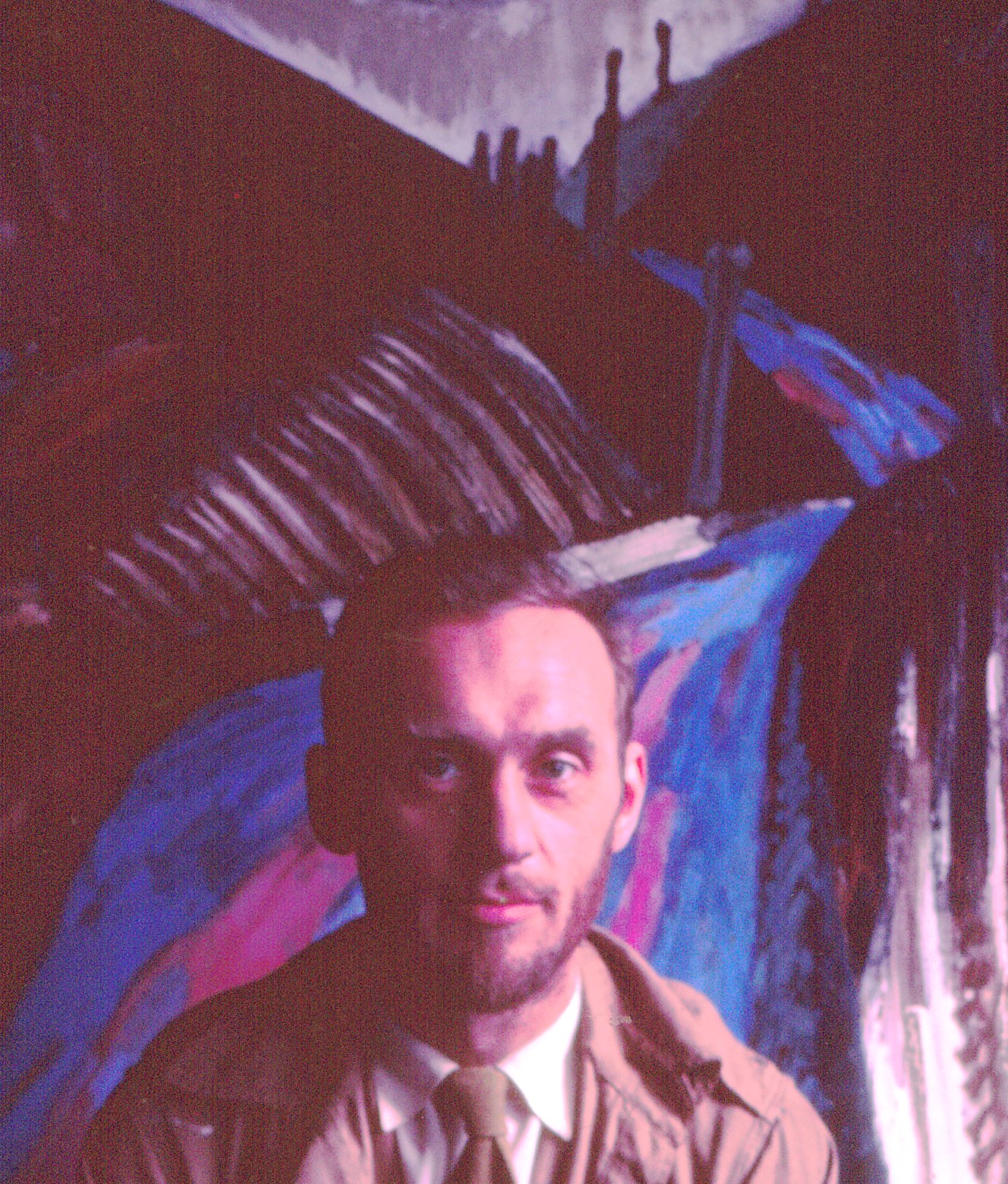
 Auto-portrait · RCA
Early life
Alistair Grant grew up in the small fishing port of Étaples, his mother's home town in North-East Normandy, where he kept a house throughout his life. Étaples is the key to his identity, both as a person and as a painter. Grant's father was half-French and half-Scottish.
Although he was born in West Kensington on 3rd June 1925, Grant was always more at home in France and only learnt to speak English at school, which he was happy to leave aged 13. For a short while he worked in a combined solicitors and estate agents office, and nurtured ambitions to become a vet. Then, deciding that art students were far better-looking, he went to study at Birmingham College of Art (1941–43). It was a traditional enough education, with much emphasis placed on still-life drawing.
After serving in Egypt with the RAF during the war, Grant returned to art school and the Royal College, where he was taught by the likes of Carel Weight and Ruskin Spear. Attracted to printmaking, he studied lithography with Edwin la Dell and etching with Robert Austin. He was to remain closely associated with printmaking all his life.
Grant became a great and justly-revered experimental printmaker. He was to work in the printmaking department of the Royal College for 35 years (1955–90), acting as Head of Department 1970–90 and as Professor of Printmaking (Emeritus) 1984–90. To many he is known only as a printmaker, but he always thought of himself as a painter first and foremost.
Chronology
Key dates
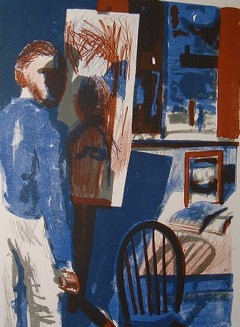
Grant — Self-portrait (auto-portrait)
The painter
Grant was also a wonderful painter. In the early 1980s his imagery had turned to an open expressionist style, with sweeping brushmarks and the introduction of new vibrant colour. Inspired by the Normandy coastline around Étaples and Le Touquet, Grant would create cyphers from the shapes and forms in the landscape, which he would offset against curtains of colour.
They evoke bright or misty days, blazing skies or sunsets, beaches or harbours. One could describe him as a French reflection of the St. Ives School where painters explored the landscape in similar fashion.